Too Many Choices? What the Famous Jam Study Says About Deciding
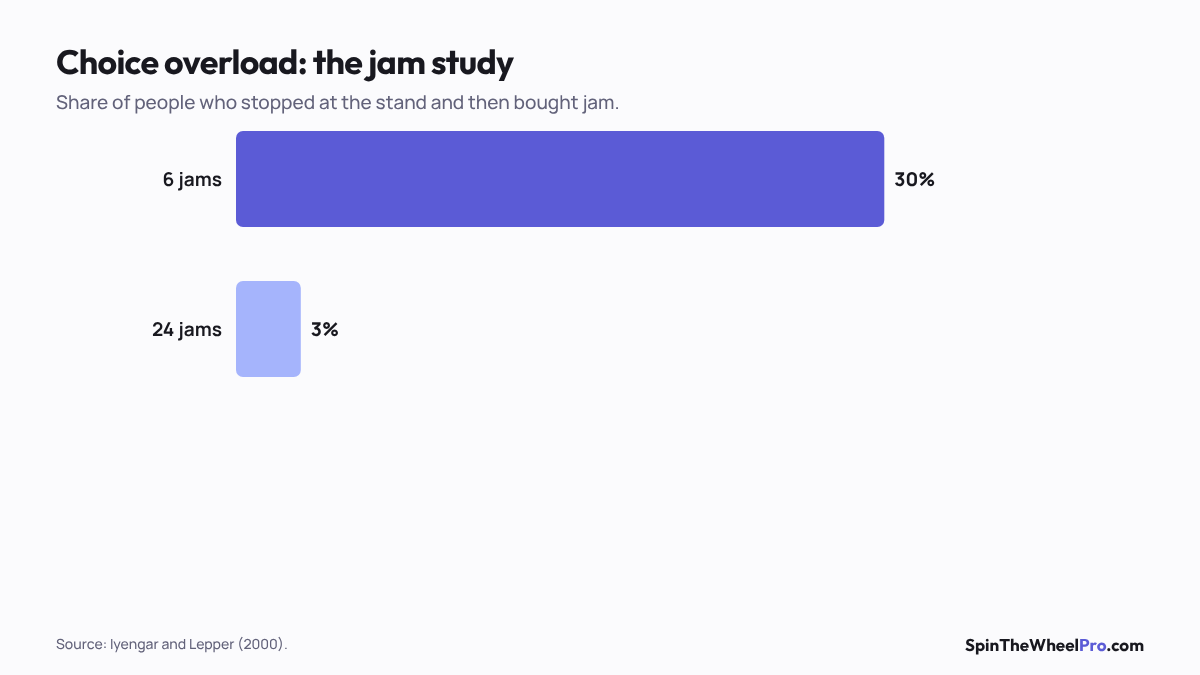
In a famous experiment, shoppers at a supermarket tasting stand were shown either 6 or 24 jams. The big display attracted more people, but only 3% of them bought a jar, compared with 30% of those who saw the small display. Too many options can make it harder to choose at all.
Key facts
- 24 jams: more visitors, but 3% bought.
- 6 jams: fewer visitors, but 30% bought.
- Later studies found the effect is real in some situations but not all.
- Narrowing your options, then letting a wheel break the tie, can end decision paralysis.
The study
Psychologists Sheena Iyengar and Mark Lepper set up a tasting stand in a California supermarket in 1995, switching between 6 and 24 varieties of jam. Their results, published in 2000, became one of the best-known findings in psychology:
| Display | Stopped at the stand | Bought jam |
|---|---|---|
| 24 jams | 60% of passers-by | 3% of those who stopped |
| 6 jams | 40% of passers-by | 30% of those who stopped |
Is choice overload always real?
Not always. A 2010 review of many similar experiments found the average effect was close to zero, but that it shows up strongly in some conditions: when options are hard to compare, when people do not know what they want, and when the decision feels important.
How to use this
1. Cut the list. Pick your top 4 to 6 options before deciding.
2. Check they are all acceptable. Only put options on a wheel that you would be happy with.
3. Let chance break the tie. Spin, and notice how you feel about the answer. Our what to eat wheel and yes or no wheel are built for exactly this.
Sources
- Iyengar, S. S. and Lepper, M. R. (2000). When choice is demotivating: can one desire too much of a good thing? Journal of Personality and Social Psychology, 79(6), 995–1006.
- Scheibehenne, B., Greifeneder, R. and Todd, P. M. (2010). Can there ever be too many options? A meta-analytic review of choice overload. Journal of Consumer Research, 37(3), 409–425.