Let a Coin Decide? What a Study of 22,511 Coin Tosses Found About Big Decisions
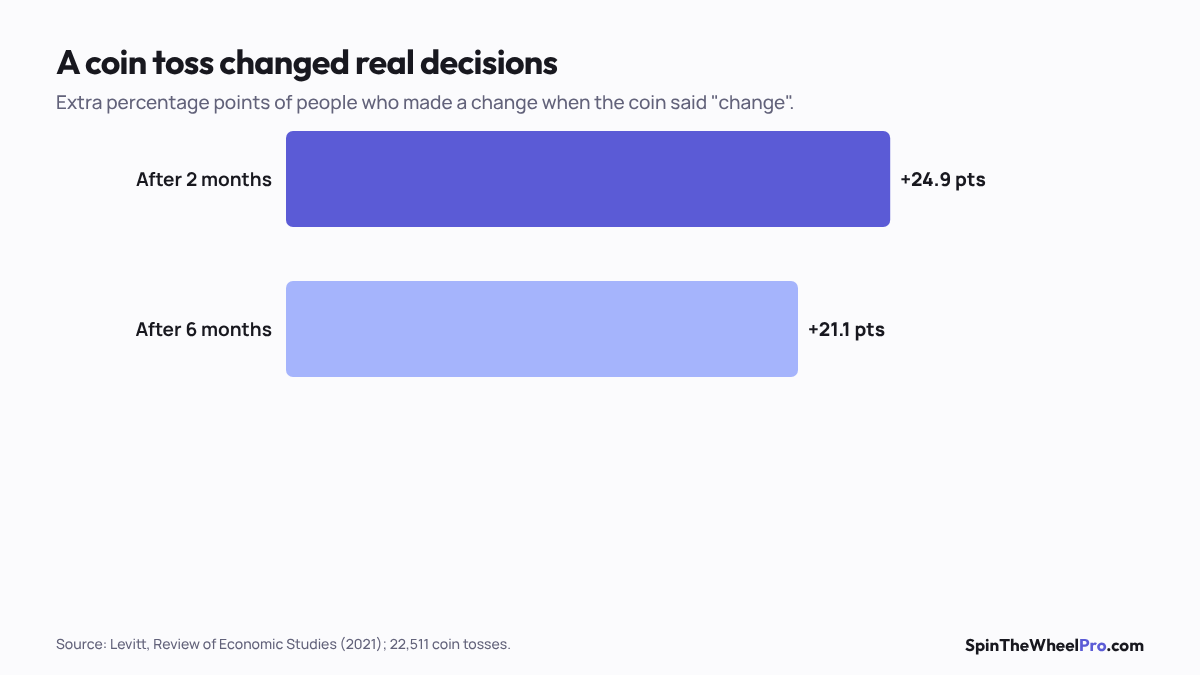
In a large study by economist Steven Levitt, people who were stuck on a decision flipped a coin. When the coin said “make a change”, they were about 21 to 25 percentage points more likely to actually make the change. Six months later, people who had made the change because of the coin were happier on average than those who had stuck with the status quo.
Key facts
- The study used 22,511 coin tosses from people facing real decisions.
- Heads (make a change) raised the chance of changing by 24.9 points at two months and 21.1 points at six months.
- People who made a change, like quitting a job, reported being happier six months later.
- The author concludes that people may be too cautious about life-changing decisions.
How the study worked
Visitors to a website could describe a decision they were struggling with, such as whether to quit their job, end a relationship, move or start a diet. A virtual coin was then tossed for them: heads meant make the change, tails meant stay as you are. The researchers followed up after two and six months to ask what people actually did and how happy they were. After removing technical problems, the study had 22,511 coin tosses.
What it found
| Finding | Result |
|---|---|
| Extra chance of making a change if the coin said so, after 2 months | +24.9 percentage points |
| Extra chance of making a change if the coin said so, after 6 months | +21.1 percentage points |
| Happiness six months later for those pushed to change (1–10 scale) | Higher, by about half a point across all questions |
For important decisions, the happiness gain was larger, though less precisely measured. The paper is careful to note its participants were self-selected and not representative of everyone.
How to use a wheel the same way
- Use the yes or no wheel for decisions you have thought about and still cannot settle.
- Pay attention to your reaction. If you feel relief, that is your answer. If you feel disappointed, you have learned what you really wanted.
- Keep it for choices where both options are reasonable. A wheel cannot weigh up risks for you.
Sources
- Levitt, Steven D. Heads or Tails: The Impact of a Coin Toss on Major Life Decisions and Subsequent Happiness. NBER Working Paper 22487 (2016); published in The Review of Economic Studies (2021).