Why the Same Name Keeps Winning: Random Looks Less Random Than You Think
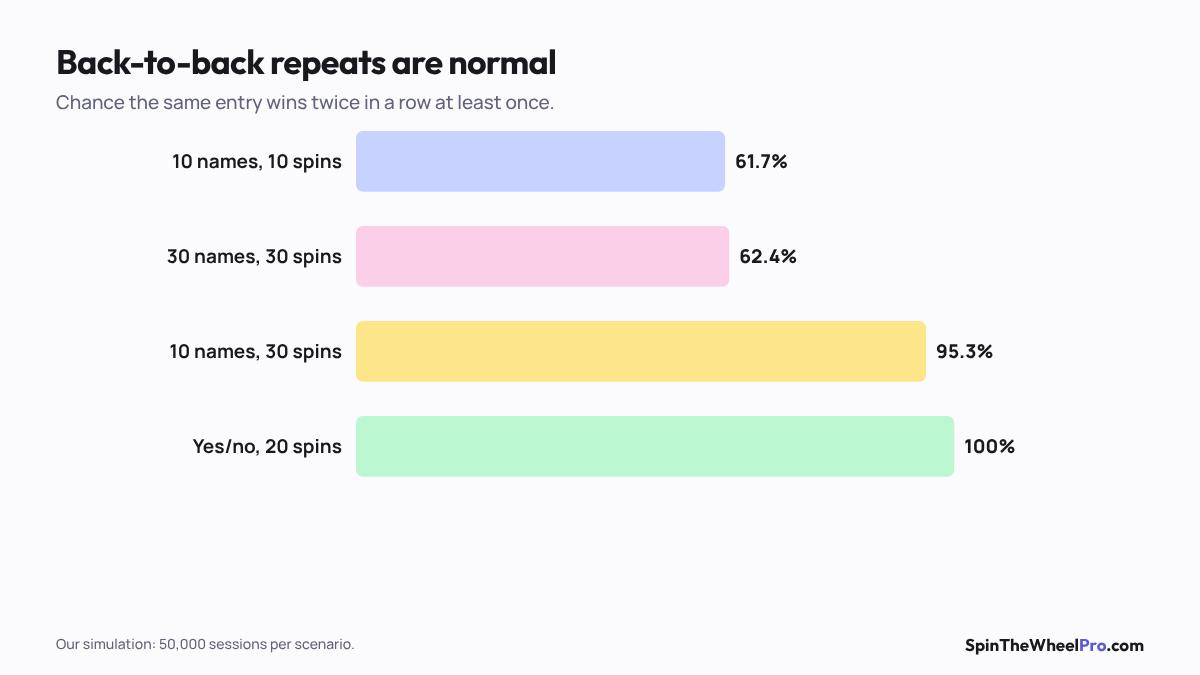
People often think a wheel is broken when the same name wins twice in a row. It is not. If you spin a 10-name wheel just 10 times, there is a 62% chance that at least one name wins twice in a row somewhere along the way. Over 30 spins, it is 95%. Repeats are not a sign of a rigged wheel. They are a sign of a fair one.
Key facts
- 10 names, 10 spins: 62% chance of at least one back-to-back repeat.
- 10 names, 30 spins: 95% chance of a repeat, and a 37% chance someone is never picked.
- 2 options (yes/no), 20 spins: the longest run of the same answer averages 4.7.
- Every spin is independent: the wheel has no memory of the last winner.
What our simulations show
We simulated 50,000 sessions for each situation below, using the same secure random generator as our wheel.
| Situation | Back-to-back repeat at least once | Average longest streak |
|---|---|---|
| 10 names, 10 spins | 61.7% | 1.7 |
| 10 names, 30 spins | 95.3% | 2.2 |
| 30 names, 30 spins | 62.4% | 1.7 |
| Yes or no, 20 spins | 100% | 4.7 |
On a yes-or-no wheel, a streak of four or five identical answers in 20 spins is the normal, expected result.
Why our brains expect less repetition
Psychologists have shown again and again that people expect random sequences to switch more often than they really do. When asked to write down a “random” coin-flip sequence, most people avoid long runs, so their made-up sequences are easy to spot. This is related to the gambler’s fallacy: the feeling that after a name has won, it is “less likely” to win again. In reality each spin is a fresh 1 in 10.
When repeats are a problem
Repeats are fair, but they are not always what you want. If you need everyone to get a turn, switch on “Remove winner after each spin”. Each winner then leaves the wheel, and the next spin is a fair pick among the rest. Our article on how many spins until everyone is picked shows how big the difference is.
Sources
- Our own simulation: 50,000 sessions per scenario with a cryptographically secure random number generator.
- Background: Gambler’s fallacy, Wikipedia.