Raffle Odds Explained: How Much Do Extra Tickets Really Help?
In a raffle, your chance of winning is roughly the number of tickets you hold divided by the total number sold, multiplied by the number of prizes. With 100 tickets and 1 prize, holding 5 tickets gives you exactly a 5% chance. With 3 prizes, those 5 tickets give you a 14.4% chance of winning at least one, slightly less than 3 × 5% because you cannot win more than once with the same ticket.
Key facts
- 1 prize: your chance is simply your tickets divided by tickets sold.
- 100 tickets, 3 prizes, you hold 5: 14.4% chance to win at least one prize.
- 500 tickets, 5 prizes, you hold 10: 9.6% chance.
- Use elimination mode on a wheel so each ticket can win only once.
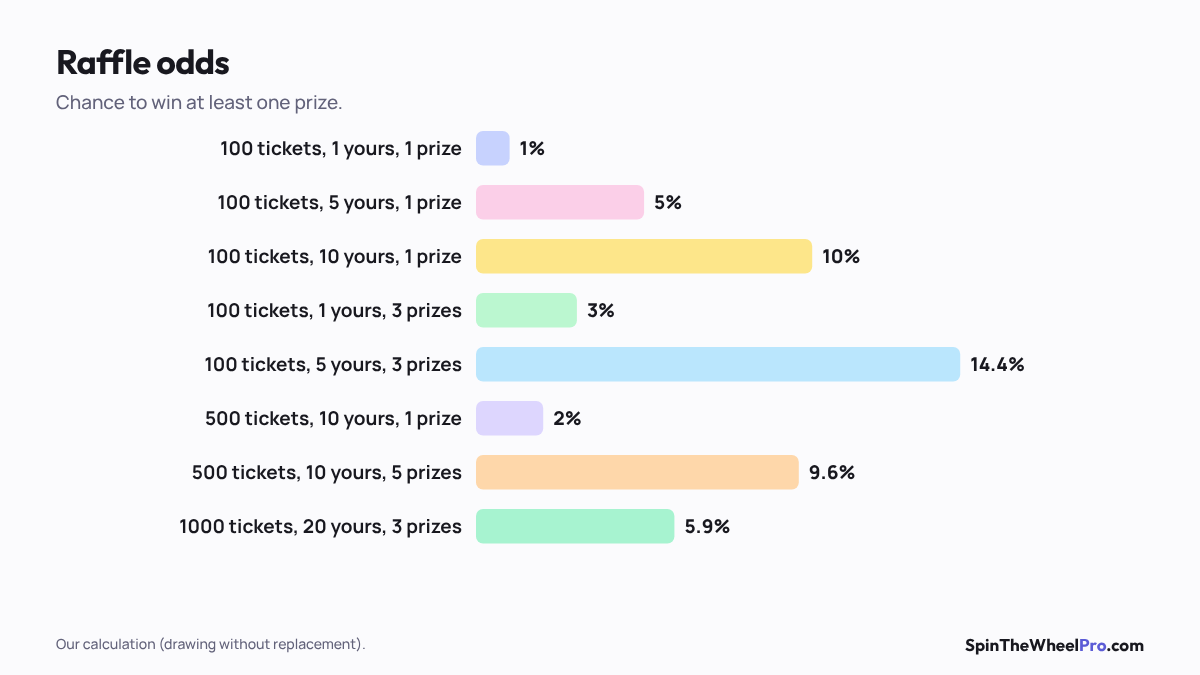
Raffle odds table
| Tickets sold | Your tickets | Prizes | Chance to win at least one |
|---|---|---|---|
| 100 | 1 | 1 | 1.0% |
| 100 | 5 | 1 | 5.0% |
| 100 | 10 | 1 | 10.0% |
| 100 | 1 | 3 | 3.0% |
| 100 | 5 | 3 | 14.4% |
| 500 | 10 | 1 | 2.0% |
| 500 | 10 | 5 | 9.6% |
| 1,000 | 20 | 3 | 5.9% |
The calculation: work out the chance that none of your tickets is drawn for each prize in turn, multiply those together, and subtract from 1. Each drawn ticket is removed before the next draw.
Running a fair raffle with a wheel
- Enter one line per ticket, for example “Sam #1”, “Sam #2”, so people with more tickets get more slices.
- Turn on “Remove winner after each spin” so a ticket cannot win twice.
- Spin in front of everyone or record the screen, and copy the results list when you are done.
See also our guide to picking a giveaway winner fairly, and check your local rules: in many places raffles for money need a licence.
Sources
- Our own calculation (sampling without replacement).
- Background: Hypergeometric distribution, Wikipedia.