Ask Someone for a Random Number and They Will Probably Say 7
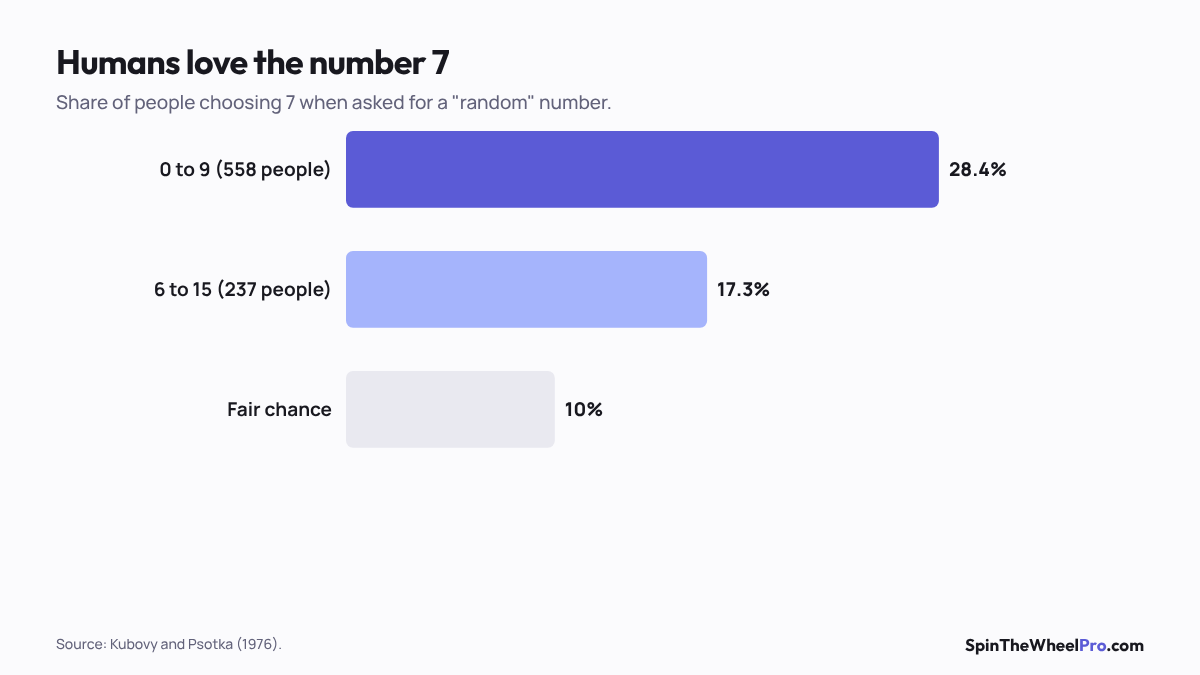
When researchers asked 558 people on a university campus to say the first digit from 0 to 9 that came into their head, 28% said 7. If people were truly random, each digit would get 10%. Humans are surprisingly bad at being random, which is exactly why a wheel or other random generator is useful when fairness matters.
Key facts
- In Kubovy and Psotka’s 1976 study, 28.4% of 558 people chose 7 from 0 to 9.
- A fair choice would give each digit 10%.
- When the range was 6 to 15, 7 was still chosen by 17.3% of people.
- A secure random generator gives every number the same chance.
The study
In 1976, psychologists Michael Kubovy and Joseph Psotka published a paper with a memorable title: “The predominance of seven and the apparent spontaneity of numerical choices”. In their first experiment, 558 people were asked for a number from 0 to 9. Seven was the clear favourite at 28.4%. In a second experiment with a range of 6 to 15, seven was still picked by 17.3%, again well above the 10% you would expect by chance.
Why 7?
The researchers suggested that people avoid numbers that feel “not random enough”: 0 and 1 seem too obvious, even numbers and 5 feel too round, and the ends of a range feel too predictable. Seven is odd, in the middle and does not divide nicely, so it feels the most random. Ironically, that makes it the least random choice.
What this means when you need a fair pick
- Guess-the-number games: if a friend picks a number from 1 to 10, guessing 7 first is a smart strategy.
- Raffles and draws: never let a person “just pick” a number or a name. Their choice will be biased, even if they do not mean it to be.
- Use a real random generator: our number wheel uses the browser’s secure generator, so 7 gets exactly the same chance as every other number.
Sources
- Kubovy, M. and Psotka, J. (1976). The predominance of seven and the apparent spontaneity of numerical choices. Journal of Experimental Psychology: Human Perception and Performance, 2(2), 291–294. Publication page.