The Birthday Paradox: Why Two People in Your Class Probably Share a Birthday
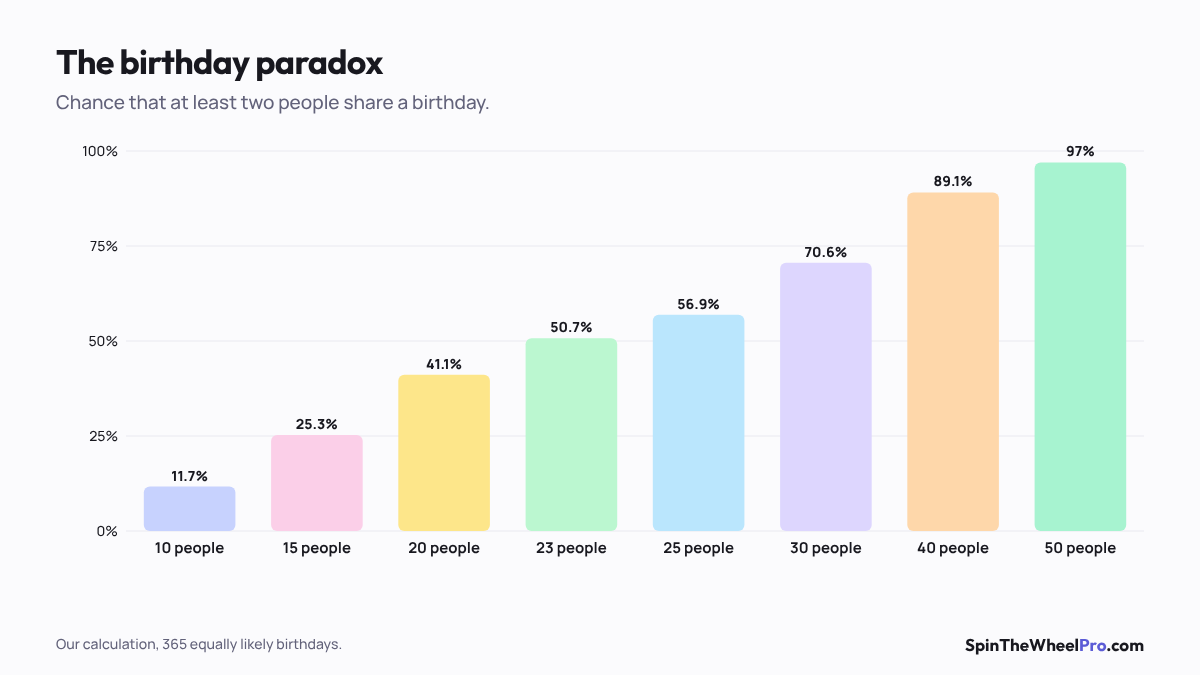
In a group of only 23 people, there is a 50.7% chance that at least two of them share a birthday. In a typical class of 30, the chance rises to 70.6%, and with 50 people it is 97%. Most people guess it would take far more, which is why this is called the birthday paradox.
Key facts
- 23 people: 50.7% chance of a shared birthday.
- 30 people: 70.6%. 40 people: 89.1%. 50 people: 97.0%.
- The surprise comes from counting pairs: 30 people make 435 possible pairs.
- Try it in class with a random month and day wheel.
The table
| People in the group | Chance at least two share a birthday |
|---|---|
| 10 | 11.7% |
| 15 | 25.3% |
| 20 | 41.1% |
| 23 | 50.7% |
| 25 | 56.9% |
| 30 | 70.6% |
| 40 | 89.1% |
| 50 | 97.0% |
These figures assume every day of the year is equally likely and ignore 29 February. Real birthdays are not perfectly even, which makes a match slightly more likely.
Why it seems wrong
We tend to think about someone sharing our birthday, which really is unlikely. But the question is whether any two people match. In a class of 30 there are 435 different pairs of people, and each pair is a chance for a match.
A classroom experiment
1. Ask everyone their birthday, or use the months wheel and the number wheel set to 1–28 to make random “birthdays”.
2. Record them on the board and look for a match.
3. Repeat a few times and compare the class’s results with the table.
Sources
- Our own calculation: 1 − (365 × 364 × … ) / 365n.
- Background: Birthday problem, Wikipedia.