How Many Spins Until Everyone Gets Picked? The Numbers Might Surprise You
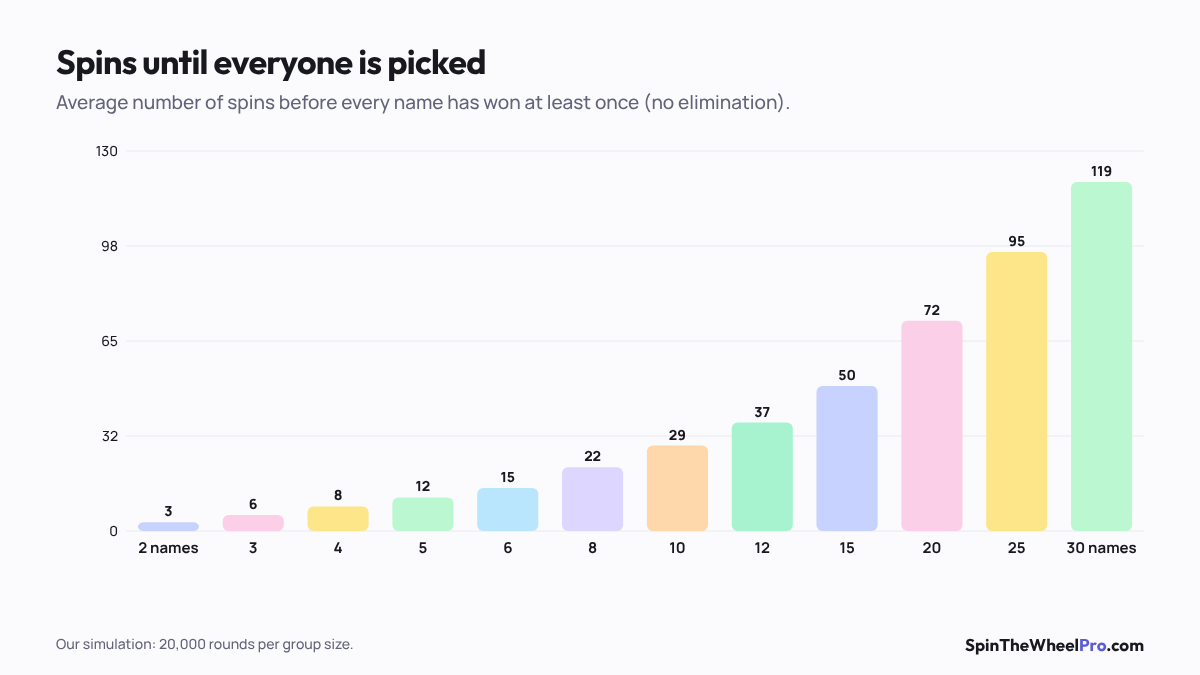
If you spin a 10-name wheel without removing winners, it takes about 29 spins on average before every name has been picked at least once. One time in ten it takes 44 spins or more. With 30 names, the average is about 120 spins. That is why teachers who want everyone to get a turn should switch on elimination mode.
Key facts
- 10 names: everyone picked after 29.3 spins on average (44 or more, 1 time in 10).
- 30 names: about 120 spins on average.
- After 30 spins of a 10-name wheel, there is still a 37% chance someone has never been picked.
- Elimination mode guarantees everyone in exactly as many spins as there are names.
The table
| Names on the wheel | Average spins until everyone is picked | 1 time in 10 it takes at least |
|---|---|---|
| 2 | 3.0 | 5 |
| 3 | 5.5 | 9 |
| 4 | 8.3 | 13 |
| 5 | 11.4 | 18 |
| 6 | 14.7 | 23 |
| 8 | 21.7 | 33 |
| 10 | 29.3 | 44 |
| 12 | 37.2 | 55 |
| 15 | 49.8 | 72 |
| 20 | 72.0 | 103 |
| 25 | 95.4 | 134 |
| 30 | 119.8 | 167 |
The averages come from a classic maths result called the coupon collector’s problem: with n names, the expected number of spins is n × (1 + 1/2 + 1/3 + … + 1/n). We checked every row with 20,000 simulated rounds, and the simulation matched the formula to within 0.4 spins.
Why the last few names take so long
The first spins are easy: almost every spin finds someone new. But once 9 of 10 names have been picked, each spin has only a 1 in 10 chance of finding the last one, so you wait 10 spins on average for that one name alone. The last name accounts for about a third of the total.
What this means in practice
- In class: if you want every student to answer once, turn on “Remove winner after each spin”. A 30-name class then needs exactly 30 spins, not 120.
- For chores or turns: without elimination, some people will be picked three or four times before someone else gets a single turn. That is normal randomness, not a broken wheel.
- For raffles: elimination stops one person winning several prizes.
Try it with the random name picker.
Sources
- Our own simulation: 20,000 rounds for each group size, using a cryptographically secure random number generator.
- Background: Coupon collector’s problem, Wikipedia.