White Elephant Rules: Which Number Is Best? (20,000 Games Simulated)
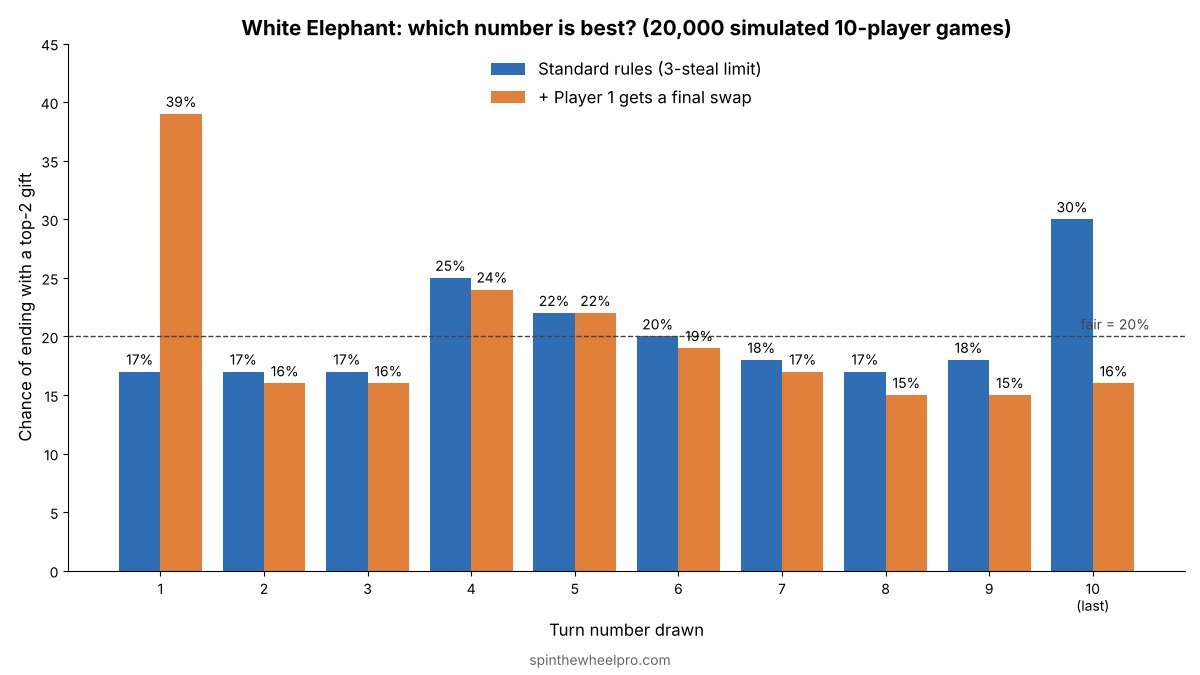
In a White Elephant gift exchange, the number you draw matters more than most people think. We ran 20,000 simulated games with a common rule set (3 steals per gift) to see which turn ends up with the best gifts. Short answer: the last number is the best seat, and numbers 1 to 3 are among the worst, unless your group adds the common “number 1 gets a final swap” variation, which flips the advantage to player 1.
Key facts
- With 10 players and a 3-steal limit, the last player ends up with one of the two best gifts 30% of the time; player 1 only 17%.
- Adding “player 1 may swap at the end” lifts player 1 to 39% and drops the last player to 16%.
- Players 2 and 3 do badly under both rule sets (16% to 17%).
- Draw the turn order with our random name picker or a 1–10 number wheel so nobody can argue it was rigged.
White Elephant rules (a common version)
- Agree a price limit and have everyone bring one wrapped gift.
- Draw numbers to set the turn order (Wikipedia, White elephant gift exchange).
- Player 1 opens a gift.
- Every next player chooses: open a new wrapped gift, or steal an opened gift from someone.
- If your gift is stolen, you either open a new gift or steal a different one. You can’t steal back the gift that was just taken from you.
- A gift is “frozen” once it reaches the group’s steal limit and stays with its owner. Wikipedia gives two steals per gift as the common limit (Wikipedia, White elephant gift exchange); our main tables use three, and the steal-limit table below shows 1, 2, 3 and no limit.
- The game ends when every gift has been opened. In some variations player 1 then gets one final chance to swap with anyone (Wikipedia, White elephant gift exchange).
Yankee Swap is often used as another name for White Elephant, and Dirty Santa is a close cousin that usually allows more stealing (Mental Floss, gift exchange rules and origins). A Secret Santa draw is different: each person buys for one assigned person, with no stealing.
Which number is best? Our simulation
We simulated games where every gift has a “real” value most people would agree on, plus a bit of personal taste. Each player steals the best stealable gift when it looks better than what’s likely still wrapped, and otherwise opens a new one. We counted how often each turn ends the night holding one of the top 20% of gifts (the 2 best gifts in a 10-person game).
| Turn | Standard rules | With player 1 final swap |
|---|---|---|
| 1 | 17% | 39% |
| 2 | 17% | 16% |
| 3 | 17% | 16% |
| 4 | 25% | 24% |
| 5 | 22% | 22% |
| 6 | 20% | 19% |
| 7 | 18% | 17% |
| 8 | 17% | 15% |
| 9 | 18% | 15% |
| 10 (last) | 30% | 16% |
A perfectly fair game would give every turn 20%. 20,000 games per column, 10 players, 3-steal limit.
Why the last seat wins: by the final turn every gift is visible, so the last player simply takes the best one that isn’t frozen. Early players open gifts blind and then get stolen from, often more than once. The final-swap rule fixes player 1’s bad luck, but goes too far: player 1 becomes the best seat by a wide margin.
Two more things stood out. Turn 4 is the second-best seat (24% to 25% under both rule sets) in our model. With 20 players, the last seat and turn 4 tie at 28%, player 1 is at 19% (39% with the final swap), and turns 16 to 18 drop to 15% to 16%. These are results from a model of how people play, not a record of real parties, so treat them as a guide to the rules rather than a guarantee.
Free to reuse: you are welcome to quote these numbers or reproduce the table above in an article, newsletter or party guide. Please credit SpinTheWheelPro with a link to this page.
The fairest rule set we found
We also tested different steal limits. The table shows the gap between the luckiest and unluckiest seat (chance of ending with one of the 2 best gifts, 10 players).
| Steal limit | No final swap | Player 1 final swap |
|---|---|---|
| 1 steal per gift | 2% to 34% (worst) | 19% to 21% (fairest) |
| 2 steals | 10% to 30% | 13% to 32% |
| 3 steals (our main tables) | 17% to 30% | 15% to 39% |
| No limit | 15% to 32% | 15% to 43% |
The surprise: a 1-steal limit plus a final swap for player 1 gave every seat almost exactly the same chance (19% to 21%). With a 1-steal limit and no final swap, player 1 almost never keeps a top gift (2%), because their gift is the first one anyone can steal. If your group wants a game where the draw doesn’t matter, use “each gift can be stolen once, and player 1 gets one swap at the end”.
How to make it fairer
- Draw numbers in public. Spin the number wheel (set it to 1 to your group size) on a shared screen, or put everyone’s name in the random name picker and remove each name as it’s drawn.
- Pick your rules as a pair. For the fairest game, use a 1-steal limit together with a final swap for player 1. With the usual 3-steal limit, leave the final swap out.
- Run it with a tracker. The White Elephant generator draws the turn order, prints number slips and a rules card, and counts steals during the game so nobody loses track.
- Use a steal limit. It stops one great gift from bouncing around all night and keeps the game moving.
- Set a clear price limit so the gifts are close in value. The closer the values, the less the turn order matters.
Stuck for a gift idea? The Christmas activities wheel has a gift ideas list you can load and spin.
Frequently asked questions
Is it better to go first or last in White Elephant?
Last, under the standard rules. In our simulation the last player was almost twice as likely as player 1 to end up with one of the best gifts. If your group gives player 1 a final swap, going first becomes the best seat.
How many times can a gift be stolen?
There is no official rule: each group sets a limit. Wikipedia gives two steals per gift as the common limit (Wikipedia, White elephant gift exchange), and our main tables use three. After the last allowed steal the gift is frozen. In our simulation, 1 steal plus a final swap for player 1 was the fairest combination.
Can you steal back a gift that was just taken from you?
Not straight away under the rules we used. Wikipedia describes the same choice: when your gift is stolen, you open another wrapped gift or steal from another player (Wikipedia, White elephant gift exchange). You must open a new gift or steal a different one.
How do you pick the order fairly?
Draw numbers at random in front of everyone. A spinner or name picker on a big screen works well for office parties and video calls.
What is the difference between White Elephant and Secret Santa?
In White Elephant everyone brings one gift and can steal. In Secret Santa each person is secretly assigned one person to buy for; our Secret Santa generator does that draw with couples kept apart and no sign-up.
Method: 20,000 simulated games per setting. Each gift has a shared value (random between 0 and 1) plus personal taste (random, standard deviation 0.15). A player steals the best stealable gift when it beats the average value of the unopened gifts by a small margin; otherwise they open a new gift. Players can’t steal back the gift just taken from them. Every rule set was played on the same 20,000 games (same gifts, tastes and wrapping order), so the 3-steal row of the steal-limit table matches the turn table exactly. Results are rounded. Sources for the rules: Wikipedia; Mental Floss (names and origins). Checked 11 November 2026.