Random Teams: The Chance You End Up With Your Best Friend
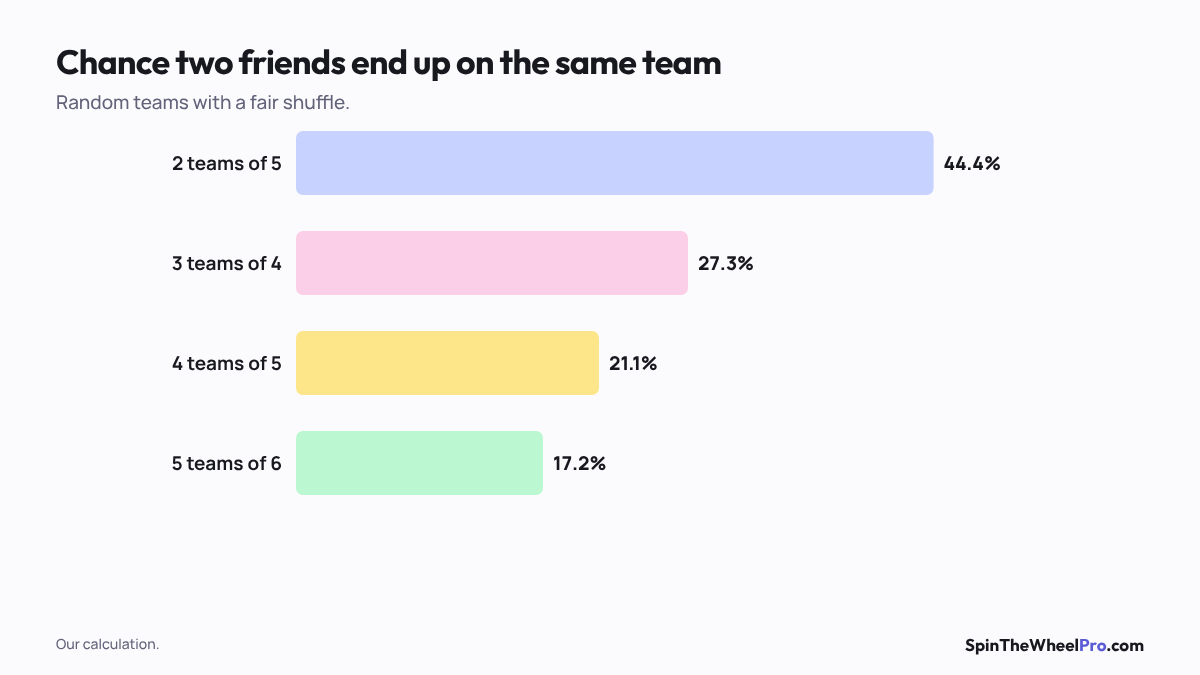
If you split 12 people into 3 random teams of 4, there are 5,775 different ways the teams can turn out, and the chance that you and a particular friend end up on the same team is 27.3%. With 2 teams of 5, it rises to 44%. Random teams really do mix people up, which is why teachers and coaches use them.
Key facts
- 12 people into 3 teams of 4: 5,775 possible splits.
- 20 people into 4 teams of 5: 488,864,376 possible splits.
- Chance two friends share a team: 44% (2 teams of 5), 27% (3 of 4), 21% (4 of 5), 17% (5 of 6).
- A fair shuffle makes every possible split equally likely.
The numbers
| Group | Possible team splits | Chance two friends are together |
|---|---|---|
| 10 people, 2 teams of 5 | 126 | 44.4% |
| 12 people, 3 teams of 4 | 5,775 | 27.3% |
| 20 people, 4 teams of 5 | 488,864,376 | 21.1% |
| 30 people, 5 teams of 6 | about 11.4 quadrillion | 17.2% |
The “together” chance has a neat shortcut: once you are placed on a team, there are (team size − 1) spots left for your friend out of (group size − 1) people. For 12 people in teams of 4, that is 3 out of 11, or 27.3%.
How a fair team picker works
Our team picker uses the Fisher–Yates shuffle with a secure random generator. It shuffles the whole list so that every order is equally likely, then deals names out one at a time like cards. That way team sizes never differ by more than one, and no split is more likely than another.
Tips for better random teams
- Want balanced skill? Put the strongest players first, use the wheel to pick captains, and let captains take turns choosing.
- Doing several rounds? Random teams naturally mix people up; over three rounds, most people will meet most others.
- Keep a copy: use the Copy teams button and paste the result into your class chat.
Sources
- Our own calculation (multinomial counting).
- Background: Fisher–Yates shuffle, Wikipedia.