Coin vs Dice vs Online Wheel: Which Is the Fairest Way to Decide?
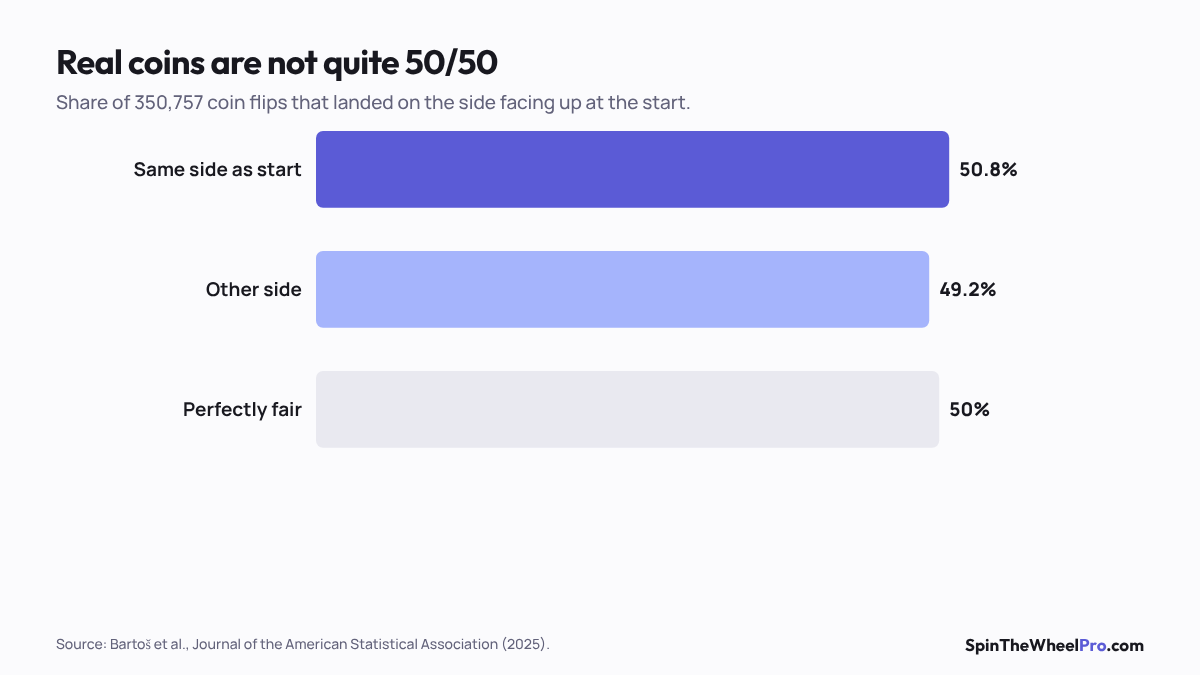
A coin toss is not quite 50/50. A team led by researchers at the University of Amsterdam flipped real coins 350,757 times and found they landed on the same side they started on 50.8% of the time. That is a small bias, but a real one. An online wheel that uses a secure random generator does not have this problem, because no physics is involved.
Key facts
- 350,757 real coin flips: 50.8% landed on the side facing up at the start.
- The bias was predicted by a physics model by Diaconis, Holmes and Montgomery (about 51%).
- Cheap dice can be slightly biased by uneven drilling of the pips.
- A secure software generator gives each option exactly the same chance every time.
Coins
In 2007, mathematician Persi Diaconis and colleagues showed that a flipped coin wobbles in the air in a way that keeps it on its starting side slightly more often, about 51% of the time. The 350,757-flip experiment, published in the Journal of the American Statistical Association in 2025, confirmed it with an average of 50.8%. If you know which side is up before the flip, you can guess right slightly more than half the time.
Dice
A standard die has dimples (pips) drilled into each face. The six face removes more material than the one face, which in theory makes the six side slightly lighter. Casino dice use flush, filled pips and precise edges for this reason. Home dice are close to fair, but not guaranteed to be.
Spinning a physical wheel
Physical prize wheels can be biased by friction, uneven weight or a spinner who learns how hard to push. That is why prize draws are often done with sealed tickets or audited software instead.
Online wheels
An online wheel is only as fair as its random number generator. Ours uses crypto.getRandomValues, the browser’s cryptographically secure generator, and picks the winner before the animation starts. In our one-million-spin test, every name came within 0.6% of a perfect share.
Which should you use?
| Method | Fair? | Best for |
|---|---|---|
| Coin | About 50.8/49.2 | Quick, casual two-way choices |
| Die | Close to fair | Board games, 1 to 6 |
| Physical prize wheel | Varies | Events, for the fun of it |
| Secure online wheel | Equal chance for every entry | Draws, classrooms, anything with more than two options |
Sources
- Bartoš, F. et al. Fair coins tend to land on the same side they started: evidence from 350,757 flips. Journal of the American Statistical Association (2025).
- University of Amsterdam: Heads or tails: pure chance?
- Diaconis, P., Holmes, S. and Montgomery, R. (2007). Dynamical bias in the coin toss. SIAM Review, 49(2).